Thursday, May 11, 2023

To France, April 2023


I was inexplicably upgraded to “premium select” seating and service on my flight to France in April, but Delta did not impress. The flight attendants seemed unprepared and stressed and possibly understaffed. Before dinner service, several of them could be seen trying to stuff boxes of fruit juice onto the beverage carts, helter-skelter, as if they had never before seen such a contraption. At one point, a woman taking care of first class came rushing back to another attendant near us, equally harried, and hissed in a voice overheard by those of us in the front two rows, “There are 35 people I’m trying to serve!” She had a wild look about her, her eyes opened wide and her hair looking like mine after a trans-Atlantic flight, not in the first hour of the journey.  But her colleague persisted in serving us, the lowly premium select passengers. 


The dinner was fine. The breakfast was horrible, an unevenly cooked English muffin with cheesy egg in between the two halves, the bottom one stuck to the cardboard container which the attendants had passed out lickety split, an hour before landing. Soggy, hard and chewy in spots, and generally bland and awful. I ate two bites of it. I hope the flight attendants got to rest a few days in Paris.


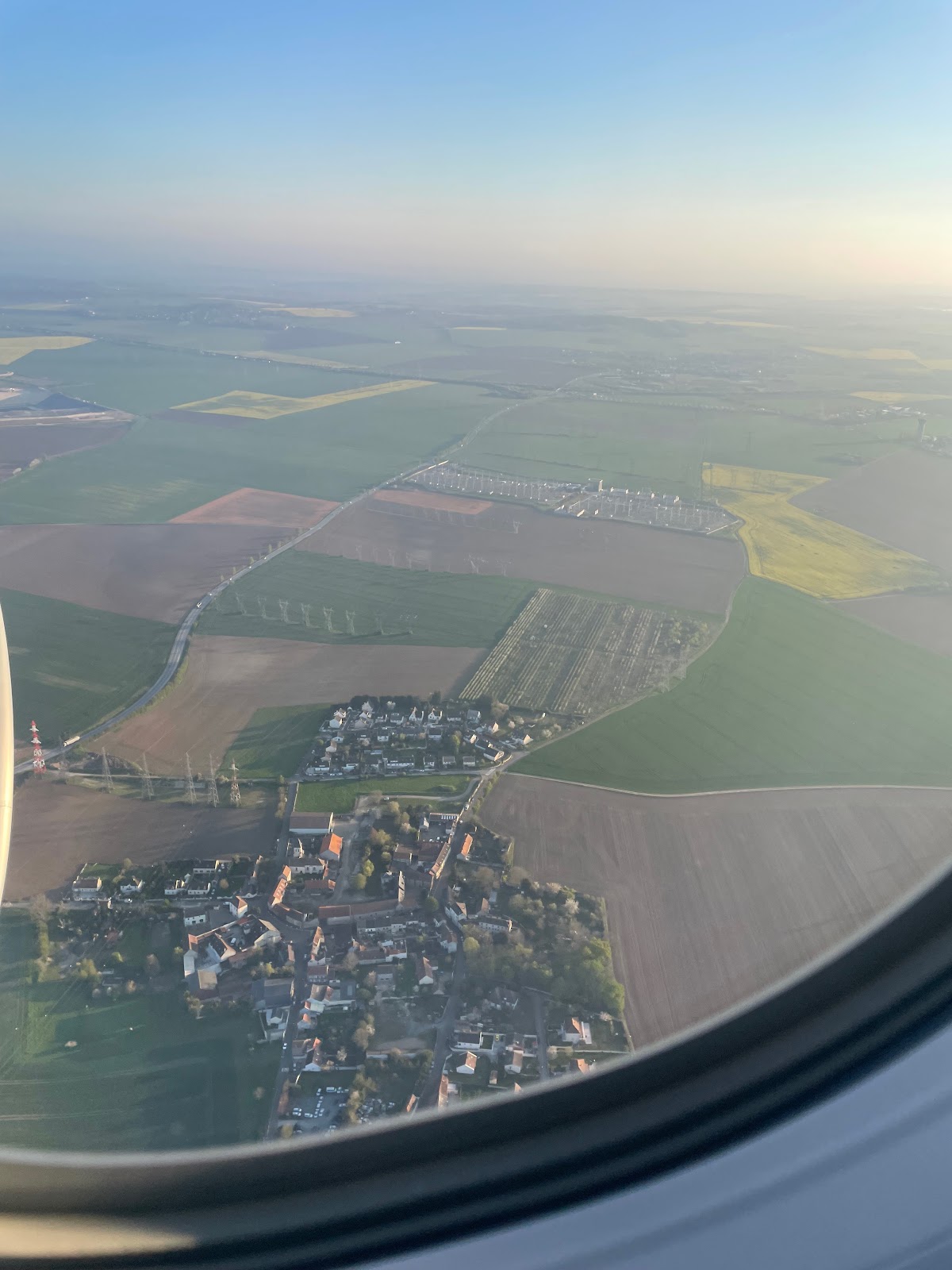
 A small town fifteen minutes before landing in France; the yellow field is colza, to make canola oil. It was in serious bloom all over Ile de France.


Walking a mile or more after deplaning in Paris at CDG is always somewhat painful, especially when you’re never sure of how much farther you have to go. You finally see the mass of tired people waiting, moving forward little by little toward border control. One entryway for Europeans, one for Americans and Canadians, and one for others. A quick pass-through for airlines’ crews. We wait, we budge inch by inch, we sweat, we cannot wait until we get out and get our bags and fall into a taxi into the city. There are workers passing between our differentiated lines, asking if anyone has a connecting flight. People timidly raise their hands. The signage is lacking so it’s easy for fatigued and frazzled travelers to be confused. The helpers walk away with them, showing them the way for transiting passengers. Those of us staying here arrive at the STOP line, waiting for the woman in charge to wave us forward, one by one. You scan your passport as she guides all three doorways for our line of travelers. I go through to the next stop, where there’s a real human French border guard. He says bonjour madame, stamps my passport, and telling me to have a bonne journée, sends me off into Paris. 


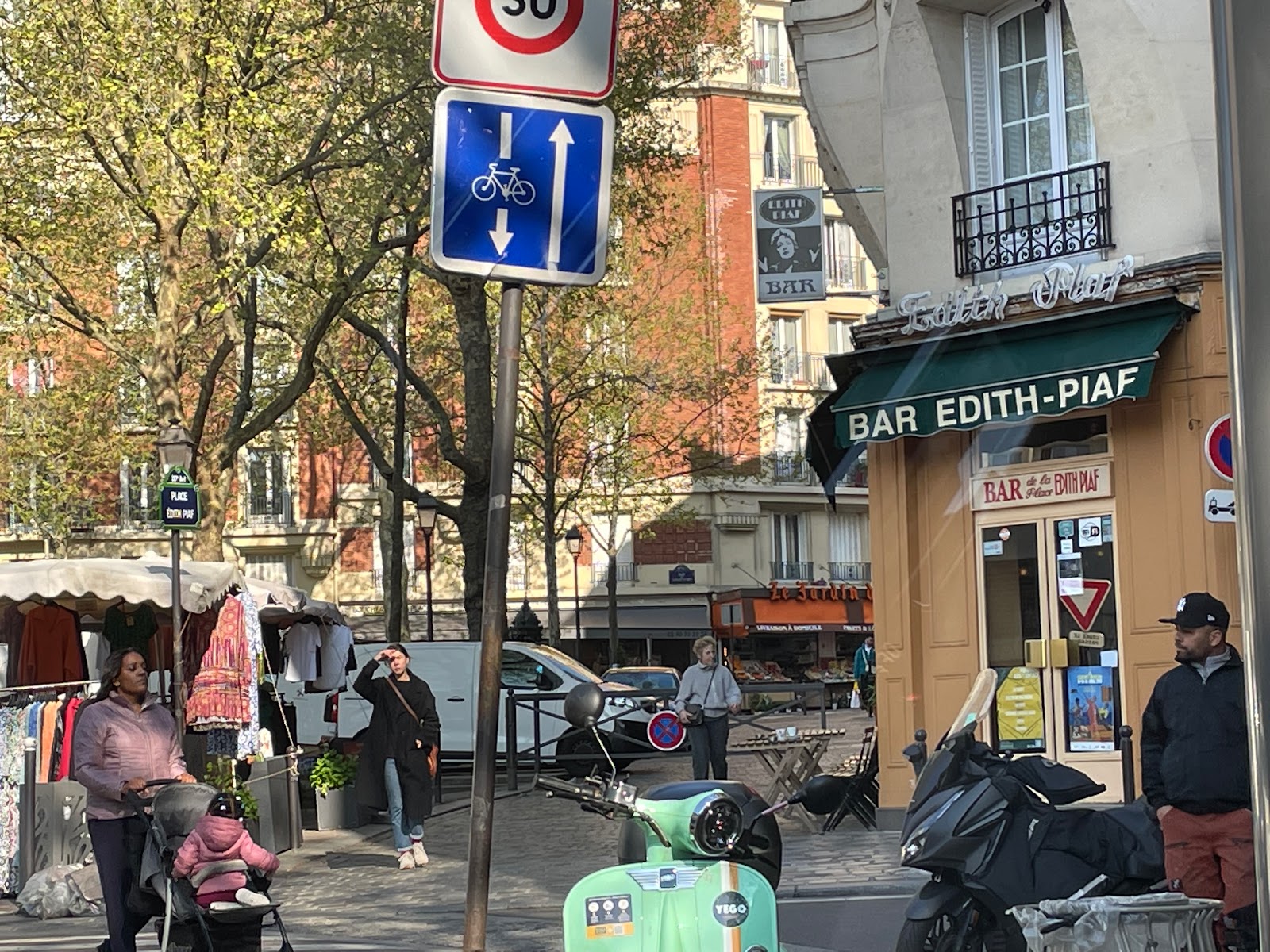
View from the taxi near Belleville, birthplace of the "Little Sparrow"

Monday, August 9, 2021

High School Civics, 1969-70


Junior year in high school, I was into hanging out with my girlfriends, listening to music, and talking mainly about boys. I could’ve cared less about school policies or the Vietnam War. I hadn’t thought much about the latter except a couple of years earlier when my older brother enlisted in the army in order to avoid being drafted and sent straight to Vietnam. ­But senior year, things began to change.

I started reading books like Eldridge Cleaver’s Soul on Ice, Brautigan’s The Pill vs the SpringHill Mine Disaster, and books on Vietnamese colonial history that turned me against the war, most likely in combination with Nixon becoming president and expanding the war with a bombing campaign in Cambodia, not to mention the persistent TV images of dead US soldiers.

As for school policy, I had been against redundant and repetitive homework ever since Mrs. Sullivan assigned my 4th grade class the task of writing Roman numerals from 1-300 in one night! That was the only time my parents called our neighbor, the superintendent of schools, at least until my senior year. Two years later, Mrs. Sullivan redeemed herself when she assigned our 6th grade class Macbeth as an end of year production; she made major revisions to the play and divvied up the three witches’ appearances so more girls could be surly on stage.

But until senior year, I hadn’t considered the dress code as something repressive, a mandatory behavioral policy that unfairly limited girls’ options on cold winter days in Cleveland, nor had I considered it a gender issue. We girls had to wear dresses or skirts that fell just above the knee and were not allowed to wear pants. No one - heaven forbid – could wear jeans to school in 1969. Then one day in the fall of our senior year, I began to take a personal interest in our school’s dress code, thanks to a social studies teacher. 

That year, I took the required class on US government with Mr. Lemington, a tall imposing older teacher who wore a suit and tie to school every day. To be a social studies teacher at our high school, you presumably had to be a card-carrying member of the John Birch Society, that far-right, white nationalist organization that strongly supported the American war effort “to contain communism” in Vietnam. The first time I entered his classroom, I was agog! Everywhere I looked were American flags, eleven in all of all sizes,  some brand new, some tattered as if they had flown on a tank or a ship in battle. All around us, there were political posters and bumper stickers imploring: “Socialism has never worked and never will”; “Impeach Earl Warren”; “End the welfare state”; and “America, love it or leave it!” These were the not-so-subtle messages this teacher and the social studies department wanted us to internalize. His colleagues, including the one we called Spoon, were generally more refined in their attempts to influence or control us, but they conveyed the same basic message. They supported the war in Vietnam, to the point of actively persuading graduating seniors to enlist.  They saw opposition to the war as unpatriotic, and they were hostile to any behavior they interpreted as questioning the status quo.

That early fall day when I started caring about the dress code,  I was walking through the halls of Olmsted High doing errands for a teacher and wearing cute new brown corduroy culottes with a hem that fell maybe three inches above my knees. Yes, higher than officially sanctioned! Spoon happened to be in the hall, coming my way. He smirked as he approached me. “Lauffer,” he said, “That skirt. Short enough for you?” “No, Spoon, actually it’s just the perfect length for this warm fall day, you asshole,” I thought as I kept walking. At that point in my life, I didn’t know that what I had just experienced was an expression of the male gaze from a person in a position of power, an expression of misogyny.

The teacher's remark bothered me but I managed to push it out of my head until later that day, at home. During our family dinner, I shared the story and my parents were concerned. This state of affairs led to the second school-related call to our next door neighbor, the superintendent of schools. The next morning at school, I was called out into the hall only to see Spoon awkwardly standing there. He apologized for what he had said to me. I have no recollection, 50 years later, of how I responded in the moment, but I know that I began to voice my objection to our restrictive dress code to my friends and anyone else who would listen.

That same month, my friend Annie and I began organizing for the Student Moratorium Day to End the War in Vietnam. Cleveland was the center of the national organization and we were drawn in after going to a march in downtown Cleveland. We spoke to our peers at high school, asking if they’d be willing to wear a black arm band on October 15th. We had kids sign up, bought black fabric at Zayre’s, and painstakingly cut out 200 black arm bands to distribute the following day. It was heartwarming, seeing so many making this statement for peace. But by lunch time, many kids had removed their black arm bands. When Annie and I asked some of them why, they let us know that the social studies teachers, Mr. Lemington and Spoon, had accosted them in class or in the hallways, and asked them to explain their decisions to support the Moratorium. The teachers pressured them to take off their black arm bands. Nevertheless, Mr. Lemington tried and failed with several students who may have been stronger in their anti-war resolve.

In parallel to our efforts to draw attention to ending the war in Vietnam (on a very different scale with different consequences), we started an anti-dress code petition, we lobbied friends in student council to vote to abolish it, we attended school board meetings in the winter to present the petition, and at least one other time in the spring to scrutinize the vote on ending the dress code. It was a lesson in civics that could have not been replicated in a classroom. In late May, two weeks before graduation, the board voted not to abolish the dress code policy but to modify it, keeping rules that the school newspaper called “petty” and “rather fussy.” Blouses and shirt had to be tucked in, no outdoor jackets could be worn in school, but hair length was no longer regulated. As the Spotlight reported, “This code went into effect Monday, May 25th, when boys started to ‘legally’ wear blue jeans, and girls appeared in slacks.” A minor victory for student agency!

Leaving OFHS that June, we felt empowered to change the world. We could question authority and disrupt negative impulses and bad policy. "Peace would guide the planets,"  and we had hope for a better world, each of us destined to make an impact! But the Vietnam War would go on for another four to five years, leaving 58,220 Americans and over one million Vietnamese people dead.  Our generation emerged from that rubble, taking different paths into our futures. As Joan Baez sang, “The years were young, the struggle barely had its start.”


Saturday, November 17, 2018

Review: An artful lunch in between Picasso and Rodin


Tavolino was a great midday find as my brother and I were between museums with our 2-day "museum pass" in Paris (Oct. 25, 2018). The pressure was on to get to as many museums as we could in our allotted two days! The previous day, we had clocked more than six miles, walking around Paris without taking a coffee or lunch break, and I was hangry by the time we got back to our AirBnB; with careful consideration, that would not happen again! So after plotting our trajectory for the following day, I searched online for a restaurant that would be a perfect layover, with the morning spent at the Picasso 
exhibit at the Musée d'Orsay and after lunch, the Musée Rodin and les Invalides.  

We were warmly welcomed at this small, cozy restaurant. I enjoyed linguini with scallops in a delightfully light, yet creamy, sauce with halved cherry tomatoes (please see photo below). My brother had the truffle ravioli which was flavorful but could have been warmer when served. The Italian rosé was perfect with our meals and with the still warm temperatures of this October. For dessert, my bro raved about the limoncello-soaked babas, and I had the café gourmand which included a biscotti, a tiny tiramisu (but not THAT tiny!), and a panna cotta topped with salt caramel that was incredible (see photo)! I requested a café allongé which was perfect with the gourmandises. My one critique is that the biscotti was wrapped in plastic rather than home-made; however, this ended up being convenient in that it was easy to save for later!
 
The food was tasty and satisfying and the service was welcoming, friendly, and attentive in a professional manner (ie, neither aloof nor overbearing). Although our reservation was for 1:30, we were not at all rushed to finish up and thoroughly savored our time there until about 3 pm. This was the perfect place, right around the corner from our next museum, to have a delicious and relaxing lunch. We were ready for Rodin’s jardin!
 
Update, May 2023: Tavolino closed during the pandemic, much to my disappointment. I had been looking forward to returning this most recent trip to Paris.


Thursday, November 1, 2018

Résistez! "Votez correctement, Madame!"


The French follow the news from the States even if this is not reciprocal for the most part; I observed this is two different places of business this week in Paris. I needed to mail a few “thank you” cards to my cousins in Germany and pick up more post card stamps, so I stopped at our local post office yesterday, Oct. 31st. Located on rue des Goncourt in the northern end of the 11è arrondissement, it is one of the friendliest places I have been to in France! I went in and stood in line and soon it was my turn. As has occurred all three times I have been there, it was a person I hadn’t seen before, and she was very helpful. (Why is there such a rotating cast of characters at the post office?) After allowing me to choose from several different possible stamps for Germany, she brought out the cubist Mickey Mouse post card stamps and the Lucie and Raymond Aubrac “Résister” stamps. I took two Mickeys and three résistance stamps, muttering that the latter were what we needed aux USA right now. The clerk started nodding her head and giggling. I said I hoped the elections next week would show some resistance, and she said she did too!


Then, on Thursday I went to the wonderful organic wine shop, Paris Terroirs, in my neighborhood at 68 rue Jean-Pierre Timbaud (11è) for a good bottle of red wine to take home to the States. The shopkeeper was very knowledgeable, not just about wines. I told him I was returning to the States the following day in order to vote on Tuesday. He asked me if that was in the "mi-termes" and I said "Oui, et c'est urgent que ça change la politique aux USA." He agreed and admonished me, "Votez correctement. Madame!" I told him not to worry, that most certainly, I would! The wine made it home unscathed and the midterms represented a big blue wave! Vive la résistance! Et le vin!

Saturday, October 20, 2018

Mittwoch in Berlin: Pink Nails


After settling into our AirBnb in Berlin, my two-week old nail polish was driving me crazy - I never pack remover when I travel, fearing a toxic leak. I had noticed several nail places near our AirBnb so I knew where to go to get these nails taken care of. After Stuffy left to pick up his rental car, I headed out, across Birkbuschstrasse to “Pink Nails.” There was a sign outside with pink writing listing services and prices. (I love that the German word for price, preis, is pronounced the same as the English word. It’s handy.)

Inside, two slightly younger than middle-age women were sitting at pink nail tables. One of them was working on a client’s nails and the other was arranging salon things. Mirrors behind them had pink ribbons hanging from them. I greeted the women and had Google translate ready to show them: Können Sie meine Nagellack entfernen? They read this translation on my phone and asked to see my nails/Nagel. The one without a customer had curly bright orange hair, which must’ve been an error in the Pink Nails shop. Her multicolored floral tattoos were visible on her exposed shoulder as she took my hand and held it aloft at several different angles to examine the polish. She announced, “Das ist nicht nagelpolitur, das ist shellac.” I responded, “Nein, das ist nicht shellac.” Then the other woman got involved and she also concluded my nails were shellacked. I asked “Was ist das preis?” to have the substance taken off my fingernails, and my clinician asked, “Zehn? (10?)” and I nodded in agreement, asking if she could file them as well (a word that seems to be a cognate in German: feilen).

Thus, the work finally began. The foil came out, the cotton part dipped in pink-toned polish remover and applied to each finger.  My clinician and I spoke a mix of English and German to each other, becoming more comfortable with each utterance. She asked, “Wohnen-Sie auf Steglitz?” and I said no, “Ich wohne auf USA, Pittsburgh, PA.” She asked why I was in Berlin, and I told her because I have eine cousine here and I am auch a tourist. She told me her English was bad and I disagreed, telling her I wished my German was better. As she filed my nails, the dust fell into a cleverly-designed hole in the center of the table, covered with a craftsman-design circular piece of metal. She said she was never good with language, that she preferred mathematics or geometry. We finished up and as I thanked her, she thanked me as we agreed that we had understood each other, auf Deutsch und auf Englisch.                                          

It felt so good to have polish- or shellac-free, clean nails, shaped into perfect little squares. But most of all, it felt good to have had a rewarding interaction with a German woman who was striving to make the world a prettier, pinker place.


Monday, February 27, 2017

Jet lag is a drag


I had all the best intentions to write an entry per day during this 2017 visit to Paris, je t’assure! But I had a difficult flight from Atlanta into CDG on Feb. 22, during which I slept maybe for 20 minutes thanks to the woman in front of me putting her seat all the way back into my space. It was ironic since I chose Air France because their flights are usually more civilized than Delta or United, with more room to breathe. Not this flight. My legs were cramped and I could not get comfortable. So I have felt terribly jet lagged since my arrival. Only yesterday (Day 5) and today (Day 6) have I felt almost back to normal, getting out of the apartment by 8:50 am today and only taking an hour long nap. My husband made me feel better by telling me that some people say that you should count on one day of jet lag per time zone traversed, which would be 6 days for me. So maybe I’m right on schedule after all. More blogging tomorrow, je t’assure encore.


Friday, May 29, 2015

Comment dire au revoir à Paris? 29 mai 2015


How do you say goodbye to Paris? 
Having your life companion with you as you prepare to leave softens the transition.  Sharing moments and scenes of the 11è with Roy…mundane moments like yesterday, stopping in the charcuterie shop on the way home, at 6:30 pm, lining up with our French neighbors, resisting the already roasted chicken, because we can get that at home in Pittsburgh next week, and choosing instead the chipolatas aux herbes with some dried (but not too dry) saucisson et some goat cheese, too, with a baguette of course.
 
I have only shed tears once recently, well, maybe twice if you count the time yesterday at the Edith Piaf exhibit at the Bibliothèque Nationale in the karaoke room when an older French woman was singing along to Hymne a l’Amour with her life companion looking over her shoulder…“je renierais ma patrie, je renierais mes amis,…”  "I'll renounce my country, I'll renounce my friends"  for you! Dieu! So moving! The scene heightened my emotions at the end of three joyful and productive months in the city of light and love. These are the moments I will remember.

The other tearful time came when I was saying goodbye on Tuesday to Sylvie, one of the women who has welcomed me so warmly in the Goutte d’Or in the 18è. As I let her know, she is an inspiration to me, working with immigrant children and families to improve their quality of life in Paris. She and I also shared life experiences of transnational and transracial marriages in our past lives, with all their joys and challenges.

Leave taking with old friends certainly helps in processing this transition. Last Wednesday, we took the RER A from Paris out to the suburbs to see Annick, the daughter of one of my dear friends in Abidjan, her husband Ivan, and their three darling children. They took us out to lunch for delicious pizza (with a little rosé). I have known Annick since she was four years old and now she is a beautiful young woman with her own family who still addresses me as "Tantie." Tonight, my old friends Elaine and Andy from Abidjan days came over and after a drink in my apartment in the 11è, we headed to Waly Fay, the Senegalese resto for thiebou dieune; they are now friends of Roy's as well.

Today, I did my final two research interviews and said au revoir to my colleagues and friends at my little school in Paris. They have been so hospitable and kind in opening their classroom doors and hearts to me, and I have learned so much about the complexities of the education of immigrant children in France from them, with still more to learn. The principal told me that it has been beneficial to them to have me around, that they have begun to discuss certain questions that I have raised about culturally relevant teaching.

Tomorrow Roy and I will walk the streets of Paris, soaking in its sights, smells, rhythm, joie de vivre. One day more until au revoir, or à bientôt...

Tuesday, May 26, 2015

Review of Septime, 11e, Paris: 26 mai 2015


Our reservation was for 8:00 pm and we were seated immediately. The only option at Septime is the seven course chef’s menu for 65 Euro per person. In summary, we felt there were great entrees, good mains, good service, ending with a strange transitional (?) dessert.

The zucchini with lightly cooked rhubarb was served with soft goat cheese under it, and was good. The soup dish, my personal favorite, was exquisite, with green beans presented in a bowl with some herbs (mint and chives, for example) that the server then covered with a tasty light fish broth that had been infused with herbs. The white asparagus and fish course was delightful. My one complaint regarding the food was that the chicken was rather rubbery, but tasted good.

As for drinks, I had a glass of rosé that grew on me, followed later by a glass of Chablis that was lovely. My husband enjoyed his Deck-Donahue Beaupres Spring Pale made in Montreuil. Be aware that the small bottle of tap water costs 4.5 Euro which we felt was excessive.

The servers patiently explained components of the various dishes, often trying in English, although at times, the code-switching made it more difficult than if they had consistently used French.  (I speak French and my husband is learning.) One issue, no matter which language, is that we had probably 6 different servers throughout the evening, which made service seem disorganized.

The meal seemed to start strongly but we were truly disappointed when the first dessert-y course was brought to the table. Here is the excerpt of our conversation at that point:
The server, placing plates on our table: C’est une mousse aux petits pois avec des fraises et des petites pousses de petits pois.
Roy: Did she just say peas?
Me: She did…

This, to say the least, was a strange dish. The pea mousse was sweetened and came with sweet strawberries. I wanted to love it! Although the color combination was quite nice, I kept hoping the aftertaste of peas would leave my mouth. It wasn’t pleasant. David Lebovitz, if you are listening, please explain! Help me understand! We engaged one of the servers in a conversation about this dish, still doubting that peas were implicated in a dessert. She confirmed it and explained that it was meant to serve as a transition from the last main dish to the sweeter boule of ice cream at the end. J’aurais pu m’en passer, merci! Overall, the experience at Septime was good, but quirky.

Attendez, one last comment: the noise level is difficult, due to terrible acoustics with the cement walls. We suggest adding some acoustic tile to ameliorate this.


Sunday, May 17, 2015

Salle des Maitres: 9 mars 2015


The teachers’ lounge or salle des maîtres is a little refuge just off the stairs on the 2nd floor. The principal is apologetic that it isn’t a larger space, but it is comparable to those in the US, perhaps only a little smaller. But there are only 14 educators in this school, including the specialists and principal. There are closed cubbies for all the teachers where they store some belongings (such as tea and sugar) and receive mail.

When I first arrived in early March during a long stretch of work without vacation days, there was one word written on the only whiteboard in the building: Euh. There is a small sink at the far end of the room with a pile of small coffee cups drying next to it. On the wall above the sink is a handwritten sign imploring people to wash any dishes or cups they use, asserting that before February vacation, the room had been left in a “lamentable state.” There is a small fridge next to the sink and counter, and on top of it is a microwave on which is placed an  espresso machine that gets a workout during recess and after lunch. There is a bag of small coffee packets that the teachers share.


My first day of data collection at the school, the principal showed me to the salle des maîtres so I could quietly await the arrival of a teacher who has agreed to welcome me into her classroom. The room sees lots of action at about 10:10 am, just after recess begins for the children. First a woman enters and greets me, and introduces herself as the PE teacher and offers to make me a café (espresso, bien sûr)! I tell her that my nephew is also a PE teacher and that he will be visiting in April, so maybe they could meet and exchange ideas. She said she would really like that!  Other teachers enter and greet us. They have much to discuss, but at 10:30, the salle clears out, and that first day, as on many to follow, I head into a classroom to observe.

Tuesday, May 12, 2015

Musee de l’Orangerie et Jardin des Tuileries: 8 mai 2015


I highly recommend this museum to any art lover or even to someone who is tepid about art. I visited on one of the many May jours feriés here in France, May 8, 2015 so there were a lot of people waiting to get in. The brief wait (10 mins?) was worth it! The two rooms in which Monet's Nymphéas or Water Lilies are displayed are peaceful for the most part, designed specifically to showcase these incredible paintings. Signs at the entry to the rooms encourage onlookers to remain quiet, and there are comfortable benches in the middle of both rooms where you can sit and contemplate these beautiful works of art.


After stopping there for a while, I headed to the basement of the museum. There are many delightful impressionist works downstairs, with a nice collection of Picasso paintings as well. There is a special exhibit of works of the Italian sculptor Wildt until July 13th this year. I entered thinking I would simply zoom through it on my way to the museum gift shop, and was pleasantly surprised by his sculptures, some of which were quite large, and most of which had some quizzical feature which caused me to do several double-takes.

I spent a lovely couple of hours at the Orangerie, and when I left, I headed behind the museum into the Jardin des Tuileries, and visited the bookstore there. It includes many lovely little offerings, such as a strong collection of children's books in English and in French.


One of my goals when I return home to Pittsburgh is to take more advantage of cultural offerings in my city. We are members of the art museums, including the CMOA and the Warhol, but we should visit more often. I would also love to attend poetry readings but typically they begin late and when you are submersed in your workaday world, it is tough to make the time.  I have truly enjoyed having the time and energy to visit all the museums and parks I have in Paris.

Sunday, May 10, 2015

Update on my scholarship: 10 mai 2015


I have interviewed everyone at my Parisian school but 2.5 teachers, and hope to complete those before we leave (obviously). I also want to do a second interview with the principal to ask about some things that have come up. Also have the two wonderful women from the afterschool program in the 18e arrondissement….one is this Wednesday, the other is the last week I am in Paris, followed by lunch with the two of them. Then there are two additional school principals, one recommended by my school’s principal and one by Hélène at the non-profit. I should remember to call them tomorrow to try to schedule them. Both have lots of experience in schools with immigrant children. I’m not a big fan of cold-calling people in Paris, just because adapting to someone’s French over the phone is always somewhat challenging; I prefer cold-emailing when I can monitor my written French. I’ve been getting some practice by calling up restaurants for reservations, and talking to AVIS rent-a-car offices to figure out where to return a car after an upcoming road trip on a Sunday (answer: randomly park it at the train station and give the keys to the SNCF reps!?!).

Most educators I have interviewed express a view that children of immigrant families are French, period. As an American, I understand that to a certain extent (although immigration has become such a political mess in the US, many people would not agree with viewing children of immigrants as Americans if they were not born in the US or formally naturalized). There is a tangible discomfort in France with the idea that immigrants, including children, hold onto other social identities, such as being African, Malian, Senegalese, Ivorian, etc., or Black, or being Muslim.

During a recent conversation with Hélène, the director of the non-profit, I asked her about this and she recounted the story of an Ivorian woman she has known since the woman arrived in Paris as a child some 22 years ago, and started attending the afterschool programs offered at the non-profit organization. At a meeting in the quartier after the Charlie Hebdo attacks, native French residents were stating that immigrants must integrate into the neighborhood and French society. This woman stood up and admonished the crowd, telling them that in the 22 years she has lived here, she has never once been invited into a French home. She asked how such integration is supposed to occur when there is such a distance between native French people and immigrants.

In an upcoming post, I will discuss how the French Minister of Education, herself an immigrant from Morocco, has addressed, since the January attacks, the role that she sees schools playing in this integration of immigrants.

Sunday, May 3, 2015

Musée de l’Histoire de l’Immigration: 29 avril 2015


In this post, I describe my visit to the Musée de l’Histoire de l’Immigration last Wednesday interspersed with stories of three incredible advocates for immigrants’ rights in France whom I have had the honor of meeting. The day after I visited the museum, I interviewed one of them who is the author of a book published last year on dignity for the undocumented, a book which is available at the museum.

There is a lovely park to the southeast of Paris called the Bois de Vincennes with two little lakes in it and many paths, easily accessible from the metro station, Porte d’Orée. I went there today to go to the Palais de la Porte d’Oree which houses the Cité nationale de l'histoire de l'immigration, or the Museum of the History of Immigration in France which has only been open since 2007.  In spite of a light and rather chilly drizzle, lots of people were walking in the park, and quite a few were entering the museum.


An article in the New York Times about the museum’s opening explains some of the contradictions I have encountered regarding immigration and social identity in this country; it also pans the museum for opening before it was ready. The exhibits seem to have improved immensely since its opening, as described in a more recent article in Jeune Afrique, written at the occasion of the museum’s official inauguration just last December (2014) by President François Hollande 7 years after its opening. The authors refer to it as “the museum that wanted to exist,” beginning as a slightly disorganized space with few visitors and now, slightly more organized and welcoming almost 300,000 people per year.

Three women I have met in Paris have impressed me with their knowledge and advocacy for full rights for immigrants in France. Two of them are associated with a Children’s Center in a quartier where many people of West African origin live, and the third person is former educator and an author of a book on the sans-papiers, or undocumented immigrants here.  I am interviewing the latter tomorrow at her house in northeastern Paris and will write more about her soon. Full rights includes the right to education, employment, housing, health care, and most importantly, citizenship.

I got to the museum around 1:30 and went straight to the gift shop to find the book Les grands by Sylvain Prudhomme, one of several being considered for this year’s Literary Prize of the Porte d’Orée to be awarded in June. Prudhomme will be giving a talk there about his book in mid-May that I hope to attend. I ended up with two additional tomes, one called Moi raciste? Jamais! (Diallo & Sassoon, 2015), and the other, a journal named Hommes & Migrations published by the Musée with articles about West African immigrants to France. I took my purchases to the café/resto for lunch before visiting the exhibits.

I’ve been thinking about inviting the director of the Children’s Center and her board member out to lunch to thank them for their openness and generosity. From my first email, they have always responded with enthusiasm and hospitality to my inquiries. The director, whom I will call Hélène, is always pulled in several directions at the same time but nonetheless makes time for me. Just this morning, I received an email from her letting me know that the woman who used to be principal at a middle school near their center has agreed to be interviewed by me. This is really great news in light of the slowly turning wheels of the French bureaucracy that has thus far prevented me from accessing schools in that neighborhood in spite of Hélène’s efforts.

As you climb the elegant stairway to get to the museum’s exhibits, there is a timeline reviewing the history of immigration in France. It’s a powerful display, showing that immigration has been an ingoing and long-term phenomenon, not a recent result of globalization/mondialisation. It reveals some historical quirks, such as the fact that Picasso was denied French citizenship in 1940.


The exhibit space itself is not well-marked so I started in the “Dons” section, full of “Gifts” from the public related to immigration, detailing family histories related to immigration. There are countless identity cards and passports, photos and relics showing the history of Italian, Polish, Portuguese, and more recently, South American immigrants. There are few artifacts from immigrants from African countries.

The main exhibit shows the history of immigration in France but seems to be divided into thematic topics. My favorite piece was an installation of bunk beds, maybe six or seven stacked up, with ladders from the floor to each bunk and African pagnes as covers on each one, and plastic market bags hanging from each bed. It addressed the difficulties in finding adequate housing that African immigrants in particular have encountered in Paris.

Although that installation by a Camerounian artist portrays a critical stance toward an issue that current  immigrants to France face, it is unclear to what degree the museum itself holds a critical stance. And maybe therein lies the problematique: the museum leadership needs to clarify and strengthen its stance, its point of view, its tone. It cannot be neutral.


Sunday, April 26, 2015

FaceTime with Luc: 21 avril 2015


My 2 year old grandson Luc and I facetimed today for quite a long while, largely due to his fascination with Parisian traffic (and his accommodating mom!). It’s the first thing he asks me about: “Show me traffic,” he says. And of course I oblige (after all, I started it!)! I hold my laptop out the window very, very carefully, aiming its camera six stories down toward rue Alexandre Dumas so that Luc has a bird’s eye view of the Parisian street where I live. Today, a special treat: he got to hear the distinctive “woo-ee-woo-eeee” siren of a sapeurs pompiers' truck careening toward an emergency. Hopefully all turned out well for those in need of their services.

Luc’s other favorite traffic moment is when the garbage men arrive in their large green and yellow truck and stop every 50 meters to empty overstuffed trash cans from the apartment buildings lining the street. The men wear bright yellow vests over their lime green jumpsuits so are tiny yet visible from our 6th floor vantage point as they noisily load and empty the trash cans. Cars, trucks, and an occasional bus line up behind the garbage truck, and the ones furthest from it often blow their horns in vain, much to Luc’s amusement. The garbage truck advances 50 meters, and the parade behind it follows. Did I forget to mention the mopeds and motorcycles? They tend to precariously weave around the rest of the traffic, entertaining my grandson even more!


Sunday, April 19, 2015

Jakob and Bree’s arrival and a bateau mouche: 9 avril 2015


My nephew Jakob and his wonderful femme, Bree, arrived in Paris last Thursday afternoon! That first day, it was initially just a joy to have them here, with their luggage, after their original flight had been cancelled due to the air controllers’ strike here in France. (Not exactly sure why USAirways cancelled a flight from Charlotte, NC, into CDG, which was virtually untouched by the strike.)


We took a taxi back to the 11e (through major bouchons of traffic) and they settled in. We headed out into Paris around 18 h to take the metro all the way to Alma-Marceau which turned out to be quite a long ride, with our destination, the Bateaux Mouches at Pont Alma. We had to wait 30 minutes for the next departure, so Bree and I shared a little bottle of white wine on the floating dock, in the sun. We got on board with a couple of busloads of tourists, and began cruising down the Seine. 


With the sun shining, we decided to sit on the outside upper deck. We were surrounded by people from all over the world: Malaysia, Italy, China, Sweden, Germany, India, and the US, to name a few countries represented on board.


The golden dome of Hotel des Invalides, where Napoleon is entombed, was visible soon after we began our trip. When Amara, Fodé, and I were in Paris in 1988, we visited des Invalides, having walked a mile to get there from the Eiffel Tower. As we stood above the grand tomb, Fodé who was 4 years old at the time, was incredulous that someone was buried there, asking in a loud voice, “Il y a quelqu’un dedans?” We tried to convince him that a former emperor of France was indeed dedans.


There were other sites on the river banks that I had never been attuned to on previous tours, such as the opening to the St. Martin canal, which leads to the Villette, seen from Anny’s nephew’s 6th floor apartment on the Quai de la Marne, and the Marais and Saint-Paul Saint-Louis Cathedral (but does the Marais truly border the Seine?). A beautiful bienvenus to Jakob and Bree!


Wednesday, April 8, 2015

Bon voyage, Anny!


Annie left this morning after just over a week here. We headed out to find her a taxi to the Gare de Lyon slightly after 7 am, toward Blvd. Voltaire. The streets were pretty quiet on this national holiday. We turned toward Nation and made it all the way to the taxi stand (a very long block) before seeing one. The driver parked and hopped out of his car to put Annie’s bag in his trunk. He was happy to accept a short fare to the Gare, only a five minute ride away. I explained where she had to catch the Air France bus, and he asked if she knew the schedule. Bien sur! She turned to thank me and tell me what a wonderful vacation she had had, and we hugged and both shed a few tears. I hope we’ll get together in Cleveland soon after I get back!

It was lovely to have a friend here, someone to sit with in cafés, with whom to go to museums and markets, with whom to eat dinner.  Relishing the simple joys of companionship and making sense of the world, together.  I miss Roy’s presence, sharing the same space with him every evening, reviewing our days, reaching out to touch him. It’s so ordinary, like brushing your teeth and having cereal for breakfast, until you’re apart for longer than is ever normal.

So having a childhood chum here was quite special and greatly appreciated! Tomorrow, it’s back to school for most of the day.